

Supply and demand are two of the most important concepts in Economics. They explain how prices are determined in a market and how buyers and sellers interact. Once you understand these concepts, many other Economics topics become much easier to learn.
In this guide, we’ll explain supply and demand using simple language and real-life examples.
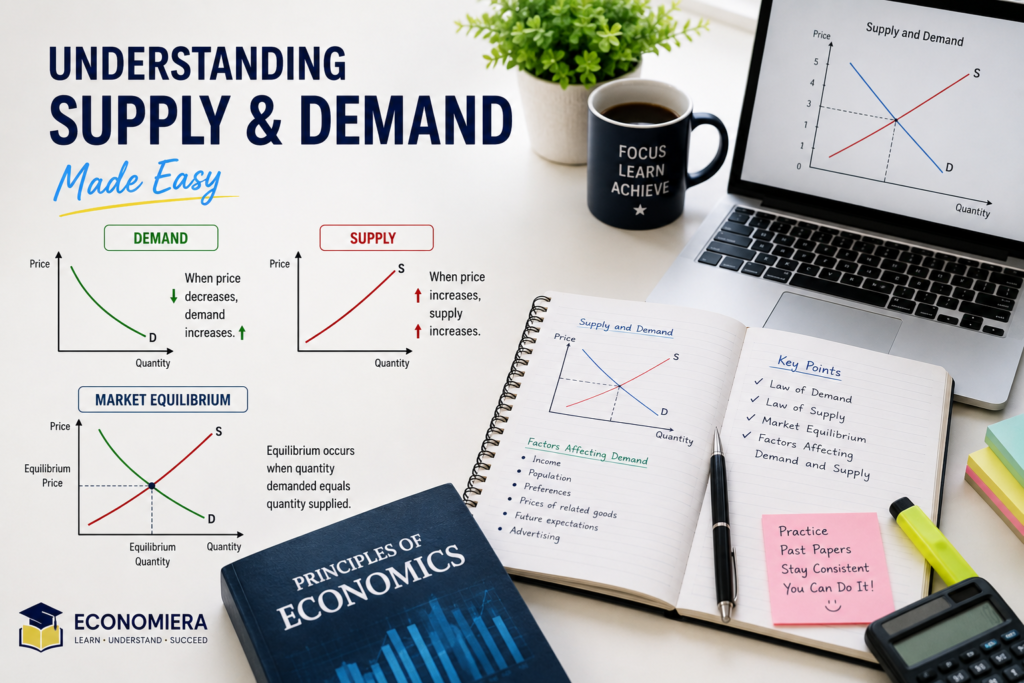
What is Demand?
Demand refers to the quantity of a product or service that consumers are willing and able to buy at different prices over a specific period.
Generally:
- When prices decrease, demand increases.
- When prices increase, demand decreases.
This relationship is known as the Law of Demand.
Example
Imagine a mobile phone priced at LKR 200,000. Only a few people may buy it. If the price drops to LKR 150,000, more people are likely to purchase it because it becomes more affordable.
What is Supply?
Supply is the quantity of goods or services that producers are willing to sell at different prices.
Generally:
- Higher prices encourage producers to supply more.
- Lower prices reduce the quantity supplied.
This is known as the Law of Supply.
Example
If the price of rice increases, farmers may decide to grow more rice because they can earn higher profits.
What is Market Equilibrium?
Market equilibrium occurs when the quantity demanded equals the quantity supplied.
At this point:
- There is no shortage.
- There is no surplus.
- The market reaches a stable price.
Equilibrium helps businesses determine the most suitable selling price for their products.
Factors That Affect Demand
Several factors can influence demand besides price, including:
- Consumer income
- Population growth
- Consumer preferences
- Prices of related goods
- Future expectations
- Advertising
These factors can increase or decrease demand even if the price remains the same.
Factors That Affect Supply
Supply can also change because of:
- Production costs
- Technology improvements
- Government taxes
- Weather conditions
- Availability of raw materials
- Number of producers
When production becomes easier and cheaper, supply usually increases.
Why is Supply and Demand Important?
Understanding supply and demand helps explain many everyday economic situations, such as:
- Fuel price changes
- Food shortages
- Inflation
- Housing prices
- Business decisions
- Government policies
These concepts are applied in almost every economy around the world.
Examination Tips
When answering questions about supply and demand:
✔ Draw clear and correctly labeled diagrams.
✔ Explain shifts in demand and supply curves.
✔ Use real-life examples.
✔ Mention factors affecting both demand and supply.
✔ Always explain the market equilibrium.
Final Thoughts
Supply and demand form the foundation of Economics. Mastering these concepts will make it easier to understand more advanced topics such as market structures, inflation, taxation, and international trade.
At Economiera, we simplify complex economic concepts through interactive lessons, practical examples, and expert guidance to help every student achieve academic success.